ERP vs CRM: key differences explained
Understanding the difference between ERP and CRM is essential for companies that want to operate in a more data-driven, efficient, and scalable way. Both are core business applications, but they serve different purposes within an organisation.
Here, we explain what sets them apart, what functions they include, and why many companies choose to use both.
What is ERP?
ERP stands for Enterprise Resource Planning and is a business management system that centralises organisational data and manages back-office processes.
An ERP system acts as a shared database for financial and operational information. It helps companies automate processes, analyse business data, and maintain internal controls.
Typical ERP functions include:
- Financial management and accounting, including budgeting and financial reporting
- Accounts payable and accounts receivable
- Inventory and warehouse management
- Procurement
- Production planning and quality control
- Supply chain management
- Human resources processes such as recruiting, payroll, and performance management
- Automation of invoicing, reporting, and administrative workflows
By consolidating these functions into one system, organisations gain real-time visibility into both financial and operational performance, enabling better forecasting and strategic decision-making.
What is CRM?
CRM stands for Customer Relationship Management and serves as a central repository for customer-related data.
CRM systems are primarily used to manage interactions with current and prospective customers and to structure sales, marketing, and customer service processes.
Core CRM functionalities include:
- Lead management and sales pipeline tracking
- Sales forecasting
- Sales process automation
- Marketing automation and campaign management
- Customer service and case management
- Management of contact details and interaction history
- Customer segmentation and profiling
- Customer self-service
CRM systems are mainly used by sales, marketing, and customer service teams to improve customer experience and drive revenue growth.
ERP and CRM functions compared
Although ERP and CRM systems often work together, they serve different purposes within a business.
An ERP system is designed to manage internal business operations, including financial management and accounting, human resources, manufacturing, supply chain management, fulfilment and inventory management, and procurement. These functions help organisations streamline processes, improve operational efficiency and maintain control over day-to-day business activities.
A CRM system, on the other hand, focuses on customer-facing activities. It supports sales management through lead management, sales pipelines and forecasting, while also providing sales process automation. CRM solutions typically include marketing automation features such as campaign management, email marketing, social media marketing and lead nurturing. In addition, they offer customer service capabilities, customer data management including contacts, segmentation and customer profiling, as well as customer self-service tools.
The fundamental difference is that ERP focuses on internal operations and back-office control, while CRM focuses on customer relationships and front-office revenue-generating activities.
When ERP and CRM work together
When ERP and CRM systems are integrated, organisations can track the entire journey from initial lead capture to fulfilment, invoicing, and customer support.
Using a shared source of data enables departments to work from the same information, reducing duplication, improving collaboration, and increasing overall business performance.
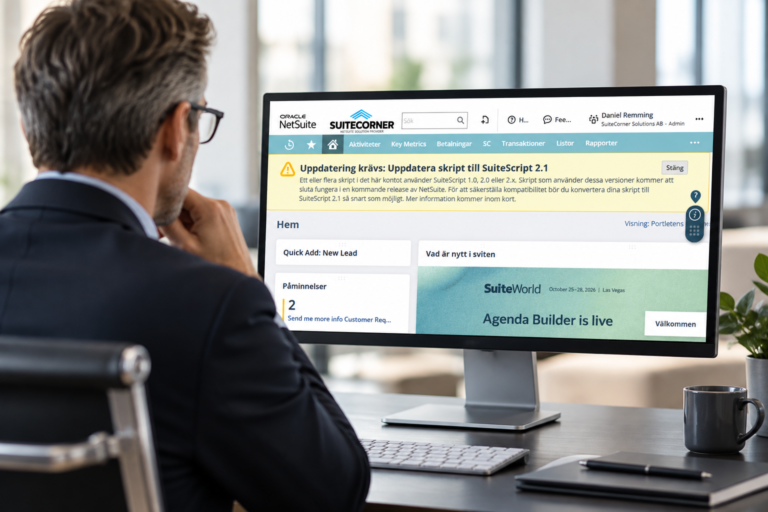
NetSuite offers a cloud-based platform where ERP and CRM operate within the same system environment.
NetSuite ERP is an AI-powered cloud business management solution that automates core business processes and provides real-time visibility into financial and operational performance.
NetSuite CRM is natively embedded within the platform, enabling companies to manage interactions with customers, partners, and suppliers in the same environment as their financial and operational data.
If your organisation is looking to strengthen internal control, improve customer engagement, and create a scalable foundation for growth, contact SuiteCorner to explore how an integrated NetSuite ERP and CRM solution can support your business objectives.